The history of bread
Staff of Life
There is a famous story told by the economist Paul Seabright about the visit of a Soviet delegation in the mid-1980s, around the time when plans were being made to transition their part of the world from a managed to a market economy. Amazed at the plentiful supply of food in the London shops, one of the delegates asked who was in charge of the supply of bread into London, clearly impressed by the remarkable job they were doing. Seabright’s answer, that no one is, is one of the most extraordinary things that we commonly take for granted.
This story is usually told as an example of how the invisible hand of the market economy is by far the most effective way of keeping people fed. But the fact that it is centred around the supply of bread is almost certainly no coincidence. Because underlying every loaf of bread is a history of trade, knowledge and desire that has dramatically shaped human history. The journey that got us to a point where everyone in London can easily buy an affordable loaf is arguably the defining story of our species. From a different angle, Seabright’s tale is not one about how a market economy is good at making bread. It is a story about how bread, and our insatiable desire for it, has been instrumental in creating the market economy.
The fall of Soviet Bloc communism was, in no small part, driven by an inability to keep the shelves regularly stocked with bread. This was not the first or last time that bread had shaped seismic political change. The French Revolution, the fall of Rome, the Arab Spring and countless others, all driven by a failure of those in power to provide wheat and bread to all. Although most of us grab bread thoughtlessly from the supermarket shelves, it is far from a triviality. It holds societies together, shapes nations and has driven division, unity, progress and conflict throughout human history. Without it, the world around us would be different in almost every way.
Beginnings
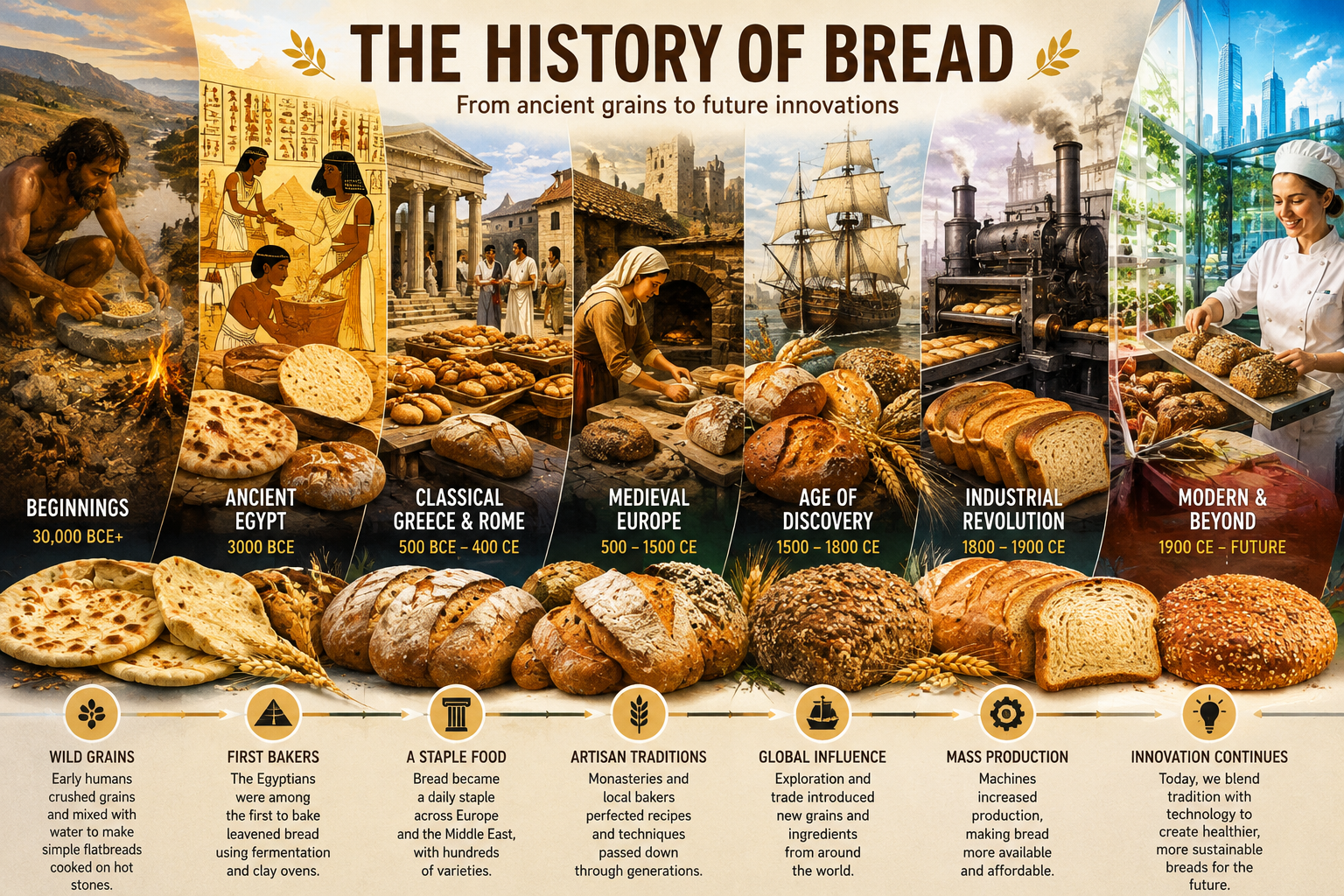
There is evidence that hunter gatherers were processing and grinding grains into a paste around thirty thousand years ago. It is likely that this paste would have been cooked somehow, although it was not until fourteen thousand years back that the first evidence of bread appears. This was produced in what is now Jordan by a nomadic people called the Natufians, who made a simple flatbread from ground wild grains, cooked on a stone heated over fire.
It is important to note that this bread, perhaps the first example we have of a recipe, predates agriculture by around two thousand years. This opens up the possibility that a desire to eat more bread was one of the drivers of crop domestication in the fertile crescent around twelve thousand years ago, where fields of wheat and barley were planted for the first time.
It is something of a mystery how and why agriculture developed almost simultaneously in several unconnected areas of the world at roughly the same point in history, but one remarkably common theme is that all those areas were eating some form of flatbread made from local ingredients. Beyond the wheat-growing regions, examples include breads from rice flour in East Asia, sorghum in Sub-Saharan Africa and maize in the Americas. Its popularity is perhaps not surprising. Bread was more portable and convenient than porridge or gruel, and also more delicious. Despite the considerable labour of grinding grain into flour, it created something that was remarkably quick to cook and easy to eat by hand.
A New Bread Rises
The next great innovation happened around 4000BCE in ancient Egypt, when a careless baker left some flatbread dough sitting around for several days, only to discover it had puffed up and risen. On baking, they discovered it had a light, fluffy texture and delicious taste. Yeast leavened bread was born and would soon take over the world.
The new technique caught on remarkably quickly and soon became an important part of culture. The story of Moses leading his people from Egypt, thought to be around 1500-1300BCE, refers to them having to eat unleavened breads because they had no time to wait for dough to rise. The lasting religious symbolism of leavening indicates just how woven it was into society by this time.
Going Professional
It was the ancient Greeks who really started to develop a baking industry, largely based on these leavened recipes, creating freestanding ovens around 1700BCE. Bakers produced a wide variety of breads in different shapes and sizes, flavoured with poppy seeds, topped with honey, or cooked on griddles. By the second century BCE, there were numerous Greek-style bakers working in Rome, with bakehouses becoming important centres of the community. A typical Roman bakery could make enough bread for two thousand people daily, utilising giant twenty-foot wood fired ovens.
Water powered flour mills were first developed in ancient Greece, although it was the Romans that created gears to make the process more efficient and built the first animal powered mills, helping to make cheaper, more refined flours, and so more affordable, delicious breads. In the seventh century CE, Persians developed the first windmills, which spread across the world, with the first reference to a European windmill appearing in 1185 AC, located in Weedley, Yorkshire. In northern Europe windmills were particularly important as watermills would be left inoperable at times of the year when waterways were frozen over.
Leavening also became more controlled than the lengthy sour dough process developed in Egypt. In Gaul and Iberia, it became traditional to skim the foam from beer and add it to dough, and in several wine producing regions the first bread starters were created from grape must, harnessing the yeast naturally present on the fruit.
Bread became a vital commodity, shaping societies and economies all across the world. Trade in grain led to ports, cities and transport networks, but also helped develop record keeping and mathematics. Much agricultural science was derived from our insatiable desire for wheat, and the capture of natural energy to drive industrial processes came largely from the need to make milling more efficient. By the Middle Ages, bread had transformed the world. Huge amounts of agricultural land were devoted to wheat and other grains. Every town had a mill and a bakery. Every region and culture had their own forms of bread. The vast majority of the global population ate some sort of bread regularly, and almost all developed societies depended upon it to feed their people.
Changing Tastes
Some recipes have remained virtually unchanged for thousands of years. The leavened breads of Egypt and the flavoured loaves from Ancient Greece would be entirely familiar to us today. Focaccia dates all the way back to the 5th Century. The extraordinary filled and topped breads of Georgia, Azerbaijan and Central Asia have their origins at the beginning of the Mogul Empire in the fourteenth century.
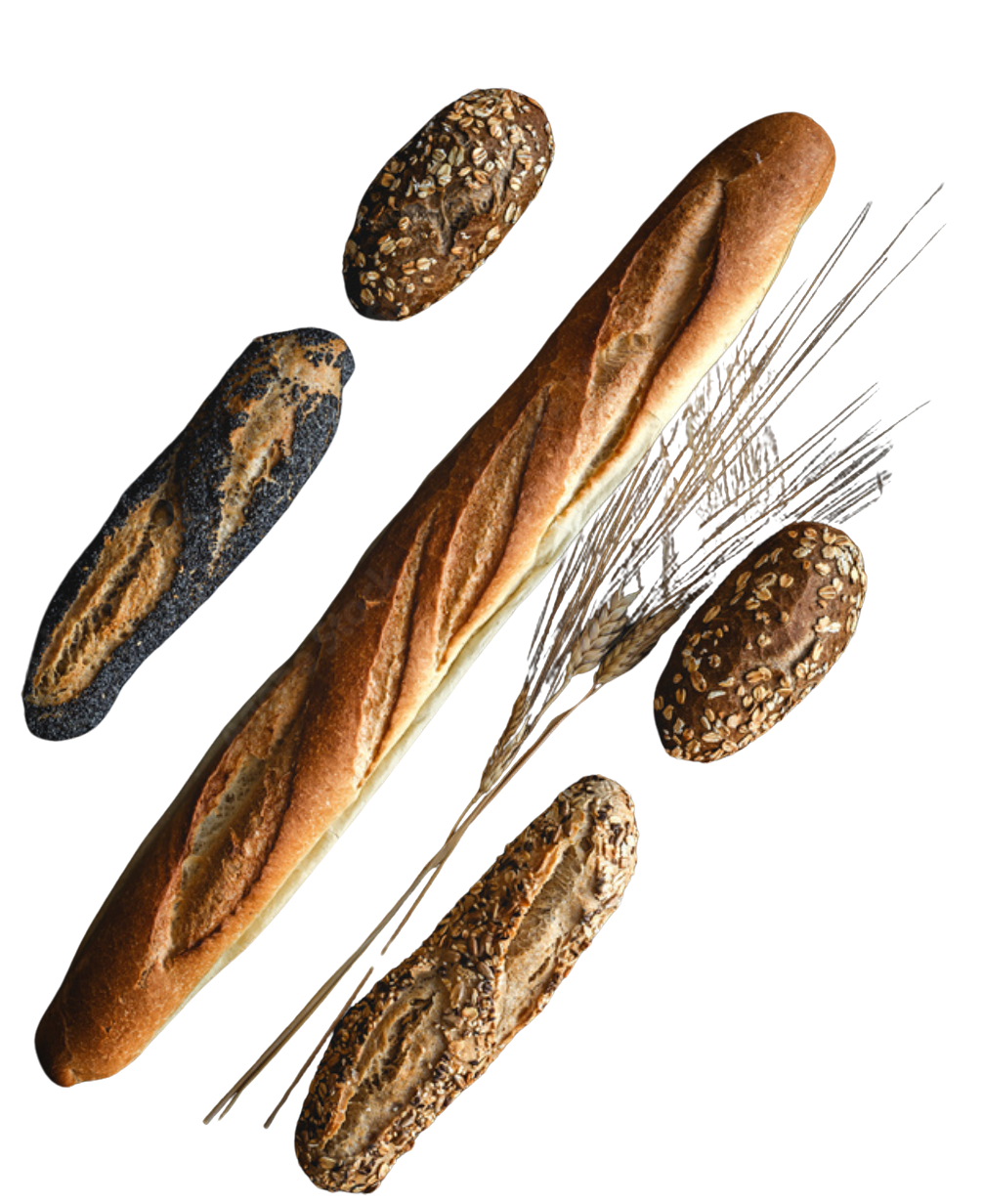
Other commonly eaten breads are more recent creations. Baguettes were first made in eighteenth century Paris but were not named Baguettes until 1920. Pizza, in its current form, was first made in 1889 to honour Queen Margherita of Savoy, topped with the red, white and green of the Italian flag. And ciabatta was developed in 1982 by Italian baker Molini Adriesi, in a bid to make a more Italian version of the increasingly popular baguette.
Bread was considered so important throughout history that it led to the dawn of consumer protection laws. In the UK, the ‘Assize of Bread and Ale Act’ of 1266 is widely considered to be the first food safety legislation and led to the pioneering appointment of food safety inspectors, known as Ale Conners. In the eighteenth and nineteenth centuries, adulteration of bread with substances such as chalk, alum, plaster, powdered bones or sawdust was commonplace among bakeries, leading to the creation of various bread acts to standardise sizes of loaves and quality of ingredients.
The best thing since…
The increased focus on safety and the rapid technological progress of the industrial revolution further drove the development of large-scale industrial milling, making refined flours cheaper, safer and more available. The mid-1800s also saw the first industrial production of yeast, opening the door to truly industrial scale baking. In the UK in the late 1800s, companies such as ABC (The Aerated Bread Company) and Warburtons achieved great success, leveraging consumer fears of inconsistency and contamination by providing branded, mass produced products with guarantees of safety and quality.
In 1928, the first industrially pre-sliced and wrapped loaf was sold, made using a process developed by American inventor and engineer Otto Frederick Rohwedder. This led to a revolution in bread sales and the rapid development of several brands such as Wonder Bread, Holsum Bread and Wonderloaf. By the 1950s, less than 20 years after industrial slicing first reached the UK, more that 80% of the bread sold there was pre-sliced.
Also in the UK, in the early 1960s, the Chorley Wood bread process was developed, dramatically reducing production times and enabling the use of lower quality domestically grown wheat. It produced uniform and extremely soft bread that was ideal for sandwiches and pop-up toasters, quickly becoming the dominant method of production in British bakeries. The process has since spread to over thirty countries around the world, especially those that struggle to produce high protein wheats and want to utilise domestic crops.
Bread is…
Bread is part of our language, woven into religious allegory, present in all of our culture. The origin of the word ‘companion’ is someone you break bread with. The word ‘Lord’ comes from the old English for ‘protector of the loaf’ and ‘Lady’ comes from ‘loaf-kneader’. ‘Bread and butter’ is used to denote livelihood. ‘Daily bread’ is a religious refrain for that which is physically and spiritually vital.
In Christianity, Jesus declares himself the ‘bread of life’. In Judaism they reflect ‘if there is no bread, there is no Torah’. In Islam, the consumption of bread is considered an interaction with the divine. In Mayan culture, it was believed that the gods sculpted humans from corn bread dough. In ancient Egypt, bread was the flesh of Osiris, god of the underworld. In Hindi culture, the first roti from a batch is traditionally given as an offering to Neivedya.
In the Grapes of Wrath, Steinbeck uses bread as a symbol of kindness and empathy. In The Hunger Games it represents hope and rebellion. In Les Miserables, a stolen loaf signifies struggle and oppression. Protestors during the Arab Spring of 2011 called for ‘Freedom, Equality and Bread’. Robert Browning opined that to taste bread was to taste ‘all the stars and heavens’. Louis Bromfield wrote that ‘Bread is the king of the table and all else is merely the court that surrounds the king’.
For fourteen thousand years, bread has been the staple food of humanity. For almost that long, it has also been a symbol of life, spirituality and hope. Despite all of our progress, and all the different foods now available to us, it is thought that 60% of the world’s population still eat bread every day. Civilisation has its roots in bread production, and however complex they might look, modern societies are still centred around delivering it into our hands.
Bread and wheat are everything. The rest of our culture is just dressing.
timeline
About the Author
Anthony Warner, better known as The Angry Chef, is an award-winning science writer, broadcaster, and food communicator with a passion for separating nutrition fact from fiction. Trained as a developmental biologist, Anthony has become one of the UK's most respected voices on evidence-based nutrition, making complex food science accessible through his books, media appearances, and public speaking. His work focuses on helping consumers understand the science behind food, health, and nutrition without the myths, misinformation, or marketing hype.